
China’s 2026 New Year Mini-Holiday Playbook: Why Douyin-Led Joy, Split-Track Travel, and “Stay-at-Home” Comfort Are Redefining Seasonal Demand
- See Qian

- Feb 12
- 5 min read
Douyin dominates the moment, and the mood is overwhelmingly positive

Data source:Hermes.datastory
As the holiday approached, social chatter and engagement climbed sharply, with total discussion volume peaking on 29 December (last-minute plans locked in) while interactions peaked earlier on 25 December, reflecting a “double-festival” warm-up effect across Christmas and New Year.
The data also suggests a separation between “information browsing” and “deep interaction” on the peak discussion day, implying that practical updates (traffic alerts, official notices) can drive reach without necessarily driving engagement.
Channel concentration is the bigger headline: Douyin accounts for 84.6% of discussion volume and 94.9% of interactions, making it the default arena for real-time celebration content.

Data source:Hermes.datastory
Sentiment stays upbeat: overall content is mostly neutral informational sharing (83.1%), with positive content close behind (15.9%) and negative content very low (1.0%).
Net sentiment is especially strong on Douyin, reaching 96–97 in late December, while Weibo sentiment “warms up” into the holiday window.
What this means for brands: Douyin should be treated as the primary “emotion + proof” channel for New Year. Build creative that is instantly shareable (joy, countdown, family warmth), then bridge to conversion with short, practical “how-to” information when discussion spikes. On Weibo, plan for entertainment news hooks and event tie-ins rather than expecting steady conversion by default.
Travel demand is back—but it is splitting into three clear lanes

Social signals show high travel intent, but the market is fragmenting into distinct preference tracks. First, the “north-south crossover” pattern remains dominant: ice-and-snow trips versus winter sun escapes.
Harbin Ice and Snow World-related routes saw bookings up 30%, while Changbai Mountain ticket volumes rose 2.7x and Snow Town (Xuexiang) rose 2x, underlining how “experience landmarks” can pull demand even in a short break.
Second, county-level tourism is surging, signalling that travellers are increasingly open to smaller, more “authentic” destinations. Some county hotel bookings grew over 5x, with others above 3x, reinforcing the shift toward less-crowded, more value-driven routes.
Third, “reverse travel” is becoming mainstream,explicitly framed as avoiding crowds while chasing value and depth. On Douyin alone, reverse travel generated nearly 200,000 interactions, with mostly neutral-to-positive sentiment.
What this means for brands: stop planning “one holiday product”. Build three:
(1) flagship snow/sun experiences with high visual drama
(2) “small-town discovery” bundles with concrete, practical planning assets
(3) reverse-travel routes positioned around calm, savings, and deeper cultural immersion.
If you can’t win on price, win on clarity。What problem are you solving: crowds, planning friction, or lack of meaning?
Cross-border travel is rebounding, and air hubs will take the strain

Data source:Hermes.datastory
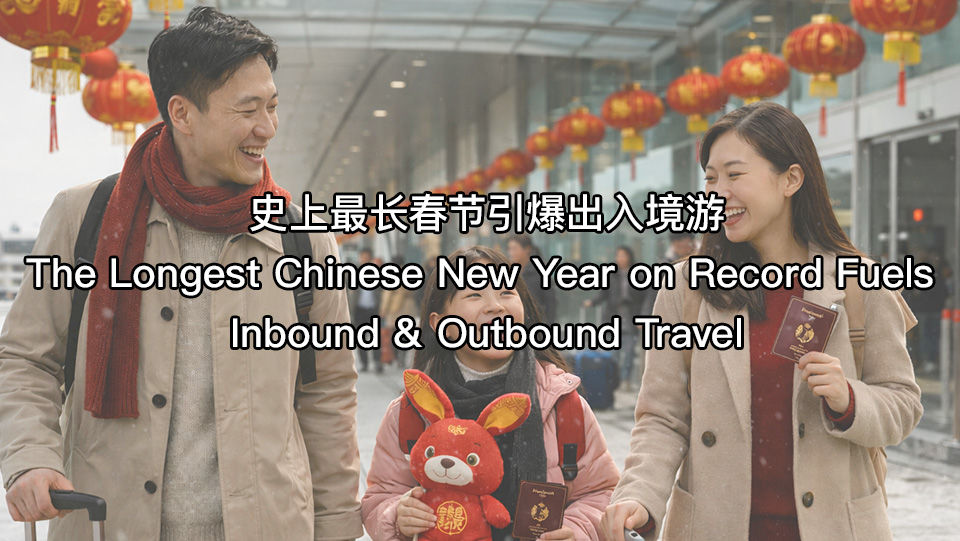
Beyond domestic “ice vs sun” and reverse travel, border-crossing demand is also recovering. Forecasts point to a meaningful New Year mini-holiday lift in daily inbound/outbound volumes, with traffic concentrating through major airport gateways — led by Shanghai, Guangzhou and Beijing. For travel retail and airport-facing brands, the implication is simple: plan for last-minute decision windows, fast proof-led offers, and clear “time-to-buy” mechanics that work in transit.
“Ritualised” experiences and “stay-at-home” comfort are rising at the same time

New Year is not just “going out”. It is simultaneously about ritual and recovery. On the “going out” side, users are seeking memorable, socially shareable experiences—concert trips, special film screenings, and theme-park countdown spectacles (e.g., castle fireworks and city light shows).
Traditional rituals are being refreshed too: interest in temple blessings (e.g., Hanshan Temple, Lingyin Temple) rose over 80% compared with the previous period, showing how “meaning moments” can compete with pure entertainment.

But the most broadly adopted behaviour is the opposite: “stay-at-home entertainment” becomes the highest-discussed, widest-participation mode, with nearly 800,000 interactions on Douyin—far ahead of other consumption modes.
Users describe home-based routines like streaming, cooking, family time, and “recharging”, reflecting a strong desire for comfort and mental rest.
What this means for brands: plan for a dual-stage New Year. Stage A is “shareable ritual” (countdowns, concerts, city landmarks, blessings). Stage B is “cosy recovery” (food, home entertainment, family bonding). Treat “宅家” as a first-class growth space, not a fallback: bundles, limited-time home experiences, and content that reduces effort will convert better than generic celebration messaging.
Policies and logistics can swing behaviour,and the fireworks debate is a prime attention magnet

Data source:Hermes.datastory
Two practical factors show up as powerful behavioural shapers. First, motorways are not toll-free during the holiday, which may push price-sensitive travellers toward rail/public transport or closer destinations.
Authorities also anticipate heavy peaks around 31 December afternoon/evening and 1 January morning, with return peaks on 3 January afternoon.
Second, the “city fireworks ban” debate drives intense discussion and complex emotions. Many users welcome “ban-to-limited” adjustments (limited time/area) as a return of “New Year atmosphere”, while others worry about safety and pollution, and a third group criticises blanket bans as overly simplistic governance.

What this means for brands: build flexibility into holiday planning. Logistics messaging (time windows, travel alternatives, local guides) can deliver reach precisely when users are in information-gathering mode. Meanwhile, policy-adjacent topics like fireworks require careful framing.Avoid taking polarising positions, and focus on safe, compliant “atmosphere solutions” (light shows, indoor countdowns, brand-led community events).
A quick platform reality-check: audiences are in different “modes”
Platform behaviour is not interchangeable. Douyin clusters around festive atmosphere and immediately useful “where to go / how to do it” content (with family/parenting themes showing up strongly). Weibo leans into cultural entertainment and city-based buzz, where film, events and outbound chatter travel fast. “Seed/grass” platforms are where people switch into planning mode: packing, itineraries, markets, and small rituals that make the trip feel “complete”. Zhihu, meanwhile, tends to sit at the macro layer: more rational, more explanatory, and closer to aviation, business, and wider social context.
Brand implications: what the data is really telling you

Consumers are not just “showing up” for the holiday period, they’re spending with slightly more confidence, and rewarding brands that reduce friction and make decisions feel easy.
Spending intent is improving. With average order value up 10% and items purchased per person up 9%, shoppers are building fuller baskets, adding extras and small upgrades across adjacent needs, not just buying the minimum. For brands, the growth unit is the scenario, not the single product: holiday demand clusters around moments like short trips, family gatherings, nights in, and countdown rituals.
Young consumers are the engine, but they’ve split into two behaviours. Post-90s drive value (40% of travel bookings; AOV up 17%), actively paying more for better experiences. Post-05s drive acceleration (bookings up 130%), relying more on platforms, trends, and social proof to decide quickly. Post-90s want “worth it” upgrades; post-00s/post-05s want simple, instantly legible bundles.
Next actions for brands
1) Give each platform a role.
Douyin: atmosphere + proof (emotion plus clear inclusions, steps, and value).
Weibo: amplification + entertainment hooks (topics that spread, then direct users to planning content).
Seed/grass platforms: planning assets + shopping lists (saveable itineraries, checklists, and credible comparisons).
Build one linked journey instead of copying the same creative everywhere.
2) Build a two-track offer system.
Go out and share: tickets, destinations, rituals, plus easy upgrades.
Stay in and recharge: food, streaming, family bundles with low friction and comfort-led messaging.
3) Segment with real offers. Fast bundles for post-00s/post-05s; clearer upgrade ladders for post-90s; predictability-first bundles for young families.
4) Turn “reverse travel” into tools.Create crowd-avoidance itineraries, simple value calculators, and credible “hidden gem” storytelling that people can follow immediately.
This market needs more helpful design — clearer bundles, clearer platform roles, and easier paths from intent to action.
Conclusion
China’s 2026 New Year mini-holiday is not a single behavioural story. It is a set of parallel needs: instant joy on Douyin, split-track travel, refreshed rituals, and a powerful “cosy at home” countertrend. Brands that win will be those that design for both shareability and ease, and that treat platform roles, planning content, and product bundles as one integrated system rather than separate teams.
If you want to turn these holiday signals into a practical execution plan, content angles, platform roles, influencer formats, and conversion-focused bundles, get in touch with China Trading Desk.


Comments