
Post–Chinese New Year 2026: Travel Momentum, Consumer Shifts, and What It Means for Luxury and Travel Brands
- See Qian

- 1 hour ago
- 7 min read
Chinese New Year remains the most important annual window for understanding how Chinese consumers travel, shop and celebrate. The 2026 Spring Festival period, marked by the longest CNY holiday in recent years, offered a particularly revealing snapshot of how mobility patterns, spending behaviour and luxury retail demand are evolving in China’s consumer market.
Across travel platforms, government statistics and market reports, several signals emerged clearly: travel demand remained resilient, consumers combined rational spending with emotional purchases, and luxury retail continued to benefit from tourism-led consumption—especially in duty-free and travel retail environments.

Source: iiMedia
Together, these signals point to a new post-holiday reality for brands operating in travel, hospitality, airlines and premium retail.
Cross-Border Travel Continues to Recover
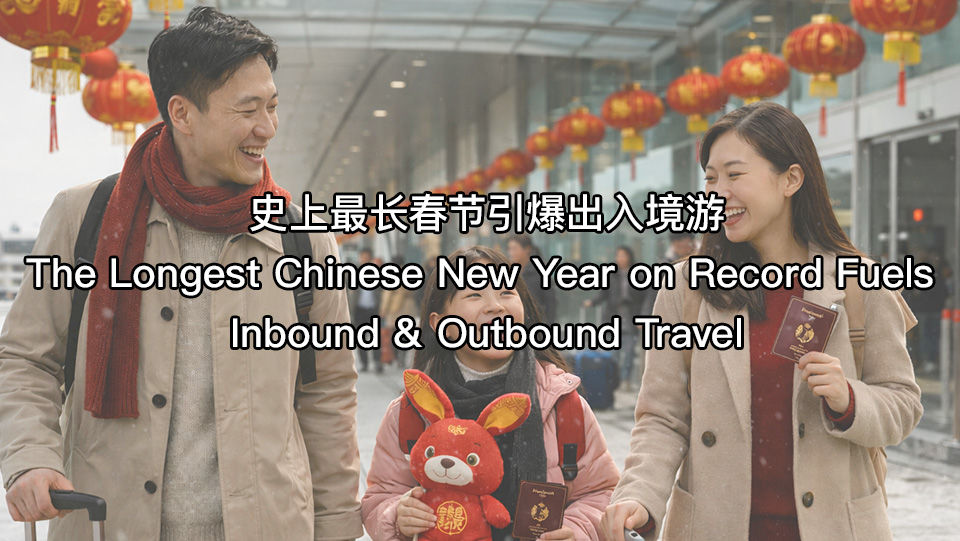
International mobility also continued to rebound during the Spring Festival.
According to the National Immigration Administration, border authorities processed 17.796 million cross-border trips during the CNY period, representing a 10.1% increase compared with the previous year. Foreign traveller arrivals rose 21.8%, while visa-free entries increased 28.5%.
These figures indicate that cross-border travel is steadily normalising, supported by expanded visa-free policies and recovering international flight capacity.
For airlines, airports and travel retailers, the continued recovery of outbound and inbound travel suggests a sustained rebound in international travel retail and tourism spending.
A Record-Length Holiday Drove Multi-Trip Travel Behaviour
One of the defining features of the 2026 Spring Festival travel season was the unusually long holiday period, which significantly expanded travel demand and encouraged more complex travel patterns.

The first peak in travel flows occurred around 6–7 February, while the main pre-holiday travel surge was concentrated on 13–14 February, as millions of travellers returned home for family reunions. The return travel peak was expected around 23 February, when workers began travelling back to major cities after the holiday period.
However, the longer holiday also created new travel patterns beyond the traditional “homecoming only” model. With more time available, travellers increasingly combined family reunions with leisure tourism, leading to multiple trips during the same holiday window.
Estimates that during the 2026 Spring Festival travel period:
13% of airline passengers travelled two or more times
Over 30% of railway passengers travelled multiple times
Both figures represent the highest levels since 2023.
For travel operators, this indicates that the Spring Festival season is no longer just a one-way migration. Instead, it is evolving into a multi-purpose travel cycle, combining hometown visits, domestic tourism and short regional trips.
Domestic Mobility Patterns Reflect China’s Urban Structure

Travel flows during the Spring Festival continue to mirror China’s economic geography.
Rail travel departures before the holiday were concentrated in major metropolitan hubs, including Guangzhou, Beijing, Chongqing, Chengdu, Shanghai and Shenzhen. These cities function as key labour and population centres, sending millions of workers back to hometowns across central and western China.
Similarly, popular domestic aviation routes included:
Shanghai – Chengdu
Guangzhou – Shanghai
Shenzhen – Shanghai
Shanghai – Shenzhen
Shanghai – Guangzhou
Shanghai – Kunming
These routes highlight the strong connectivity between major economic regions and tourism destinations.
Regional travel clusters also remained strong. Intercity travel within major urban clusters such as the Yangtze River Delta, Pearl River Delta, Beijing–Tianjin region, Southwest and Central China generated significant short-distance travel demand.
This reinforces a broader trend: China’s domestic tourism ecosystem is increasingly regional and short-haul, with travellers making multiple shorter trips rather than a single long holiday.
First-Time Flyers and Young Travellers Are Rising

Another notable travel trend during the 2026 Spring Festival was the growing participation of new and younger travellers.
According to the Tongcheng report, the number of first-time airline passengers increased by more than 30% year-on-year, with young travellers representing the majority of these new flyers.
Among first-time travellers:
35% were aged 18–26
About 6% were under 18
This trend highlights the expanding accessibility of air travel and the increasing participation of younger generations in domestic tourism.
For airlines and travel brands, this group represents an important future market—one that values digital services, personalised recommendations and social-media-friendly travel experiences.
AI Is Beginning to Shape Travel Planning
Technology is also playing a larger role in travel planning.
During the Spring Festival travel rush, questions related to travel planning submitted to Tongcheng’s AI travel assistant DeepTrip increased by more than 100% week-on-week.
This reflects a broader shift toward AI-assisted travel decision making, where consumers rely on intelligent tools to navigate ticket shortages, optimise travel routes and compare options during high-demand periods.
For travel platforms and brands, this trend suggests that AI-driven trip planning and recommendation engines will become a key competitive differentiator.
Travel is translating directly into luxury and duty-free consumption
One of the clearest links between travel recovery and retail performance came from Hainan.
According to China Customs, during the Spring Festival holiday, Hainan’s offshore duty-free market recorded RMB 2.72 billion in duty-free shopping sales, up 30.8% year on year. The number of shoppers reached 325,000, up 35.4%, while the number of items sold rose to 1.997 million units, up 21.9%.
The same report notes that retailers saw stronger traffic beginning roughly two weeks before the holiday, and that zodiac-themed limited-edition items were especially popular with travellers.
Consumer Behaviour: Rational Yet Emotionally Motivated
Beyond travel data, consumer behaviour during the holiday period revealed a balance between practicality and emotional spending.

Source: iiMedia Report | Research data on Chinese New Year gift box consumption behaviour in 2026
Research from iiMedia shows that China’s gift economy continues to expand, reaching RMB 1.449 trillion in 2025, with projections suggesting the market could reach RMB 1.619 trillion by 2027.
However, today’s consumers are more selective. They prioritise:
Value and practicality
Health and wellness
Emotional resonance and cultural meaning
Based on the report from Flywheel, It it shows that 2026 festive consumption was shaped by two parallel forces: on one side, rational consumption returned to practicality and value, driven by more thoughtful gifting, deeper health focus and clearer value-led spending; on the other, emotional consumption continued to rise in importance, driven by luck and auspicious symbolism, broader ritual-led scenarios, and indulgent, shareable festive experiences.
This helps explain why consumers became more cautious overall, while still spending actively in categories that delivered emotional payoff, cultural relevance or stronger festive meaning.

Festive products that combine these elements—such as health-focused gift boxes, cultural collaborations and symbolic New Year items, tend to perform particularly well.
In effect, the market is no longer dividing neatly into premium versus mass, or rational versus impulsive purchases. Instead, spending is increasingly organised around purchase logic: some products justify themselves through usefulness, health benefits or gifting practicality, while others win through mood, symbolism, novelty or social expression. The strongest festive products are often those that bridge both sides at once, feeling practical enough to justify purchase while still meaningful enough to give, share or remember.
This shift reflects a broader transformation in Chinese consumption: purchases increasingly function as expressions of identity, emotion and cultural connection, rather than purely material acquisitions.
Travel-related spending is moving towards culture, experience and self-reward
The Flywheel report also shows that travel demand is becoming more experience-led. During the 2025 CNY period, domestic travel reached 500 million trips, while total domestic tourism spending reached RMB 677 billion, up 5.9% and 7.0% respectively.

Source: Flywheel
The same page shows strong growth in culturally linked leisure demand, including:
skiing group-buying orders up 182%
intangible cultural heritage group-buying orders up 139%
folk fair group-buying orders up 462%
This gives travel and hospitality brands a strong angle: consumers are not just travelling more, they are actively buying into local culture, experiential leisure and “worth-sharing” moments.
Luxury and beauty brands should read this as a signal to localise value, not just prestige
Luxury and premium brands should not interpret festive demand purely through the lens of status consumption. A more accurate reading is that Chinese consumers are increasingly willing to spend when products combine symbolism, cultural relevance, practicality and emotional reward. In other words, purchases during the Spring Festival are often motivated not only by prestige but by the meaning a product carries within a festive or social context.

Source: Flywheel
The audience structure in the Flywheel report helps explain this dynamic. Emotional consumption during the New Year period was led by groups such as “New Year explorers” and “emotional connection seekers”, who prioritised emotional value, family feelings, ritual, good fortune and unique experiences.
These consumers were more closely associated with categories such as snack foods, drinks, beauty and personal care, and pet-related products. By contrast, rational consumption was driven by traditional guardians and health-conscious households, who focused on certainty of value, practicality, health and socially appropriate gifting, and were more strongly linked to alcohol, fresh and convenient foods, wellness products and household daily-use items.
The report also highlights the strength of beauty consumption during the festive period. During the CNY campaign, beauty and personal care sales on Taobao reached RMB 9.12 billion, up 11.4% year-on-year, confirming cosmetics as a key category for both self-gifting and social gifting.
At the same time, travel-size and experience-oriented product formats increased by 68.8%, showing strong demand for portable, scenario-based products that fit travel and social occasions.

Even premium purchases still require clear justification. Products that combine practical utility with emotional meaning—such as health-linked beauty, portable formats, curated gift sets and occasion-based bundles, perform particularly well. In today’s market, localisation therefore goes beyond festive colours or zodiac graphics; it requires understanding how products help consumers express care, signal taste, travel more easily or create meaningful festive rituals.
What This Means for Brands
Travel demand remains strong, but behaviour is evolving.
The longer Spring Festival holiday encouraged multi-trip travel and regional tourism, meaning brands should engage travellers across multiple moments rather than a single peak journey.
Tourism and retail are increasingly interconnected.
Travel destinations such as Hainan show how tourist flows can directly translate into luxury and duty-free spending, especially when products are tied to festive gifting and travel scenarios.
Consumer spending combines rational and emotional drivers.
Chinese consumers are balancing value, health and practicality with purchases linked to ritual, symbolism and celebration. Products that combine utility with emotional meaning tend to perform best.
New travel demographics are emerging.
Younger travellers and first-time flyers are expanding the consumer base, creating opportunities for brands to engage audiences through digital tools, AI-assisted planning and personalised experiences.
Luxury demand is shifting toward experience and relevance.
Premium purchases are increasingly tied to real-life moments such as travel, gifting, reunion and self-reward, rather than status signalling alone.
Looking Ahead
The 2026 Spring Festival season suggests that China’s consumer economy is entering a phase of structural change. Travel is becoming more flexible and experience-led, while purchases are more intentional and closely tied to lifestyle moments.
For travel, hospitality and luxury brands, success will increasingly depend on connecting mobility, experience and cultural relevance into a single consumer journey.
Conclusion
Understanding these shifts is essential for brands looking to capture the next wave of Chinese travel and consumption growth.
If your brand is exploring opportunities in China’s outbound tourism, travel retail or digital marketing landscape, our team regularly analyses consumer behaviour, platform trends and cross-border travel insights to help businesses make informed decisions.
Feel free to reach our team for more insights into China’s evolving travel and consumer market.


Comments